Estimate your mold removal costs in under 60 seconds. Our tool factors square footage, growth severity,
room accessibility, and Gilbert, AZ regional labor benchmarks to deliver an instant, transparent estimate.
Instant Mold Removal Estimator
Step 1 of 4: Affected Area Size
1234
Estimated Remediation Cost Range
$1,600 – $3,400
Reflects standard IICRC S520 containment, HEPA air filtration, antimicrobial treatment, and drying for a medium area in Gilbert, AZ.
Clearance Verification & Air Quality Testing$200 – $550
Get an Exact On-Site Binding Quote
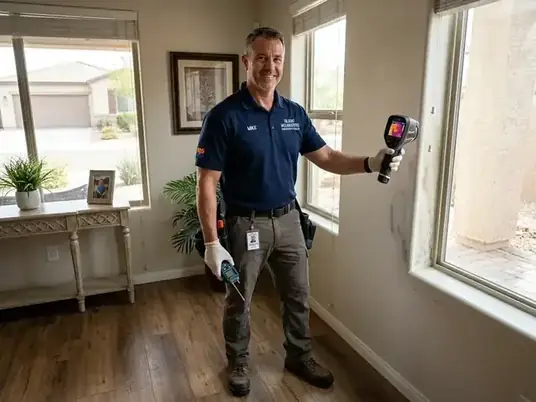
Every infestation is unique. Our IICRC-trained specialists provide comprehensive on-site inspections
with infrared thermal moisture mapping across all Gilbert neighborhoods.
How Much Does Mold Remediation Cost in Gilbert, Arizona?
In Gilbert and the greater Phoenix East Valley, residential mold remediation costs typically range from
$1,100 to $3,400, with a municipal median average of $2,100. When
calculated on a surface area basis, professional contractors charge between $10 and $25 per square
foot depending on structural accessibility, material porosity, and containment requirements.
While Arizona is famously arid, our desert microclimates present distinct mold amplification vectors. Summer
temperatures topping 115°F force HVAC air handlers to run continuously, producing gallons of condensation daily.
When drain pans clog or condensate PVC lines crack inside insulated attics, moisture accumulates undetected until
staining appears on the ceiling below. Similarly, severe July and August monsoon storms introduce heavy localized
rainfall that penetrates parapet wall flashing, tile underlayment, and stucco weep screeds. Within 24 to 48 hours
of moisture contact, indoor mold colonies can double in surface size.
Regional Cost Comparison: Arizona vs. National Averages (2026)
Metro Area / Region
Typical Cost Range
Average Project
Cost Comparison Index
Gilbert, AZ (East Valley)
$1,200 – $3,400
$2,100
Baseline Arizona Rate
Mesa & Chandler, AZ
$1,150 – $3,350
$2,050
Near Baseline
Scottsdale & Paradise Valley, AZ
$1,500 – $4,200
$2,600
+20% Higher
Phoenix Metro Area (Countywide)
$1,300 – $3,600
$2,200
+5% Higher
National U.S. Average
$1,500 – $3,800
$2,350
+12% Higher
Note: Ranges cover IICRC S520 physical containment, negative air HEPA scrubbing, antimicrobial sanitization, and controlled drying. Drywall reconstruction and finishes are estimated post-clearance.
Area Specifics
Mold Removal Cost by Room & Building Zone
Where mold grows dictates labor intensity, containment complexity, and structural equipment requirements.
Tight, unventilated attics and HVAC plenums require higher containment rigor than accessible ground-level bathrooms.
Bathroom & Vanity
$500 – $1,500
The most frequent remediation site in residential homes. Caused by shower grout fatigue, tub surround caulking
failure, or supply line pinhole leaks behind vanities. Most localized bathroom jobs are contained and remediated in a single day.
Drywall & Framing
$1,000 – $3,200
Porous gypsum drywall absorbs water quickly, allowing mold mycelia to colonize internal cellulose paper.
Requires a 24-inch controlled flood cut above the water line, framing HEPA vacuuming, and antimicrobial encasement.
Attic & Roof Decking
$1,500 – $4,200
In Gilbert, summer attic heat accelerates fungal sporulation if roof tiles leak or bathroom exhaust vents discharge
into the attic space rather than through the roof deck. Demands negative pressure ducting and dry-ice blasting or abrasive scrubbing.
HVAC Ducts & Air Handler
$1,500 – $4,800
Mold inside AC coils or flex ductwork poses the greatest respiratory risk, as spores circulate whenever the blower
activates. Involves negative-pressure vacuum collection, EPA-registered fogging, and replacement of contaminated fiberglass duct board.
Crawl Space / Foundation
$1,500 – $4,500
Historic Gilbert homes and stem-wall foundations with moisture seepage require heavy debris clearing, subfloor
antimicrobial wipe-down, and the installation of a 12-mil reinforced vapor barrier to stop subterranean moisture intrusion.
Whole-Home Contamination
$6,000 – $15,000+
Occurs after catastrophic supply pipe ruptures or unattended vacancies during monsoon season. Involves multi-zone
containment airlocks, whole-structure drying, complete flooring tear-out, and comprehensive post-remediation clearance testing.
Professional Protocols
What Drives the Cost of Certified Remediation?
Legitimate remediation is structural decontamination, not mere surface cosmetic cleaning. Professional
contractors adhering to the IICRC S520 Standard must invest in specialized containment,
certified personal protective equipment (PPE), and continuous commercial filtration:
Beware of "Quick Bleach" Quotes: Spraying chlorine bleach on porous drywall only whitens surface stains while feeding moisture to subterranean mold roots. Proper remediation always requires physical removal of non-salvageable porous drywall.
Field Protocol: IICRC-certified remediation specialists establishing critical negative-air containment barriers during a residential water damage remediation in Gilbert, AZ.
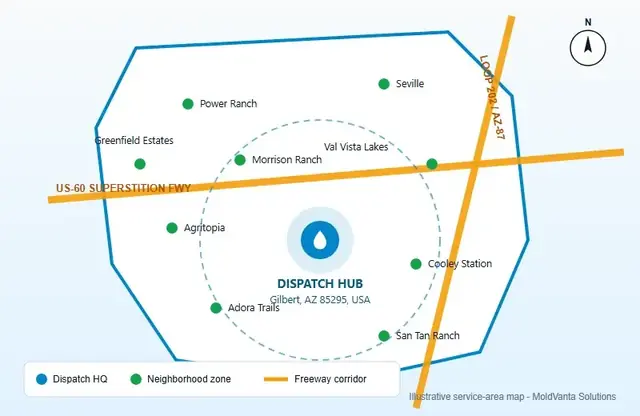
Dispatch Coverage: Rapid 30-to-60 minute emergency mold and water extraction dispatch across Gilbert, Mesa, Chandler, and East Valley enclaves.
Insurance & Billing
Does Homeowners Insurance Cover Mold Remediation?
Insurance coverage hinges on the primary cause of water intrusion. In Arizona, carriers distinguish sharply between sudden perils and gradual neglect:
Covered Perils: Mold stemming directly from sudden, accidental water damage—such as an indoor copper pipe burst, water heater tank collapse, or dishwasher supply line rupture—is almost always covered up to policy limits (typically $5,000 to $10,000 mold caps).
Excluded Perils: Mold resulting from long-term unresolved leaks, deferred roof maintenance, chronic bathroom humidity, or regional groundwater flooding is generally excluded without specific endorsements.
Direct Carrier Billing: MoldVanta Solutions provides comprehensive moisture mapping documentation, digital thermal imaging records, and standardized Xactimate line-item estimates to streamline claims with all major insurance providers.
Health & Safety Standard
EPA Guidelines: DIY Cleanup vs. Professional Remediation
The U.S. Environmental Protection Agency (EPA) provides strict threshold guidelines to help homeowners evaluate when personal cleanup is safe versus when certified containment is mandatory.
When DIY Cleanup is Acceptable (<10 Sq Ft)
Affected surface area is less than roughly 10 square feet (a 3ft by 3ft patch).
Growth is limited to non-porous or semi-porous surfaces (ceramic tile, porcelain, metal, solid finished wood).
No musty odors are present in adjacent rooms, and no family members suffer from respiratory illness or immune suppression.
The water source was clean tap water (Category 1) and resolved within 24 hours.
When Professional Remediation is Mandatory (>10 Sq Ft)
Infestation exceeds 10 square feet or extends behind baseboards into wall cavities.
Mold has colonized porous drywall, ceiling tiles, attic fiberglass insulation, or HVAC ductwork.
Water intrusion involved grey or black water (Category 2/3 plumbing sewage or monsoon runoff).
Suspected toxigenic species such as Stachybotrys chartarum or Aspergillus are visible.
Frequently Asked Questions
Frequently Asked Questions About Mold Remediation Costs
Common questions from Gilbert property owners regarding pricing, insurance claims, and inspection accuracy.
Most residential remediation projects in Gilbert fall between $1,200 and $3,500, with an average project cost
of roughly $2,100. Contractors calculate pricing between $10 and $25 per square foot based on accessibility,
spore containment level, and whether structural drywall or insulation must be removed. Small, surface bathroom
treatments can cost as little as $500, whereas multi-room remediation after flooding can exceed $10,000.
This calculator is updated with 2026 Maricopa County labor benchmarks and IICRC S520 equipment standards.
It provides an exceptionally accurate budgetary range for planning purposes. Because mold often spreads
invisibly inside wall cavities or beneath subflooring, an on-site physical inspection with moisture meters and
infrared cameras is required for a binding, final estimate.
Insurance typically covers remediation if the mold was caused by a sudden, covered water peril (like a burst
supply line or broken water heater). Gradual leaks occurring over weeks or months, deferred maintenance, and
exterior floodwaters are usually excluded unless an optional mold endorsement was purchased. MoldVanta
Solutions works directly with adjusters to supply the requisite photographic and moisture documentation.
The EPA advises that surface areas under 10 square feet on non-porous surfaces (such as bathroom tile or metal)
can be safely cleaned by homeowners using detergent and water. However, if mold spans drywall, ceiling insulation,
or HVAC ducting, or if you suspect toxic black mold (Stachybotrys), professional HEPA containment is essential
to avoid cross-contaminating your home's central air.
In the East Valley, summer attic temperatures frequently exceed 130°F, necessitating strict safety rotations,
full respirators, and specialized exhaust ducting. HVAC duct systems require negative-air vacuum machines, coil
disinfection, and often flex-duct replacement to ensure spores are not blown throughout living areas.
A complete IICRC S520 quote covers plastic containment barriers, commercial HEPA negative-air filtration,
controlled removal and bagging of contaminated materials, EPA-registered antimicrobial biocide application, and
structural dehumidification. Independent third-party post-remediation clearance air testing is generally
itemized separately ($300–$600) to ensure zero conflict of interest.